
The scholarly study
A Riverbank Resplendent
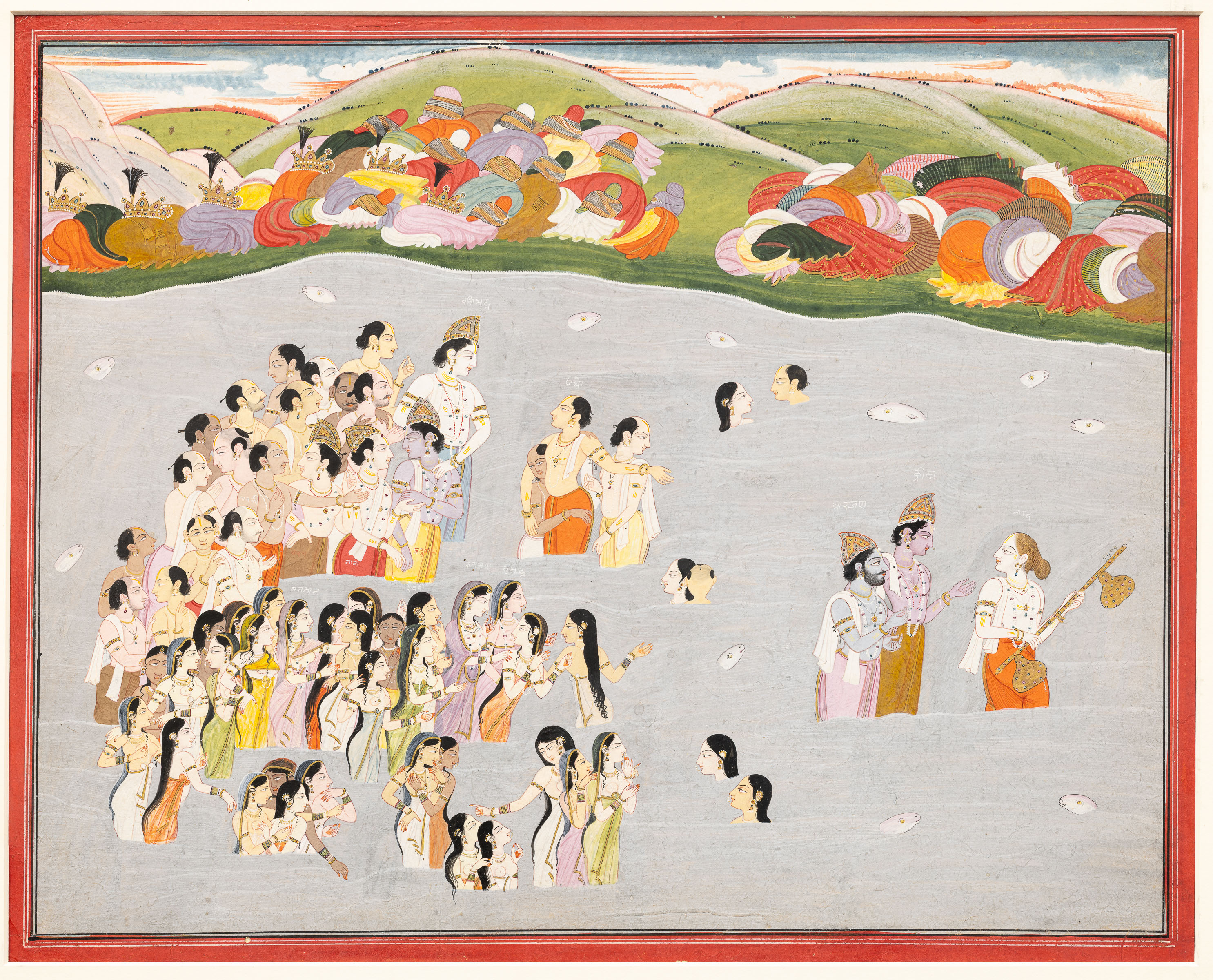
Along the bank, garments gather in sumptuous little hills: coral sleeves, lavender folds, saffron turbans, and crowns laid softly upon the green. Below them, pale water opens a luminous expanse. The painting holds these two registers in exquisite balance—the abundance of things set aside and the spaciousness of bodies at ease. Turning profiles and answering hands give the bathing company its quiet rhythm; at the lower right, the company parts around a more measured exchange.
Sotheby’s identified the scene as Krishna, Narada, and Arjuna conversing while their companions look on, and attributed the folio to Purkhu. The long-necked stringed instrument marks the presence of Narada within the exchange. The gathering belongs to the expansive narrative world of the Harivamsa.
The proposed date, circa 1800–1820, places the folio within the Kangra tradition of the Punjab Hills. A richly peopled narrative unfolds with remarkable clarity: each group has its own tempo, yet the open water carries the eye from one encounter to another. Detail never overwhelms interval. The crowded bank and the quiet reach of the river allow the page to breathe, making a small painted world feel at once intimate and capacious.
Object record
- Title
- An Illustration from the Harivamsa: Krishna, Narada and Arjuna converse while their companions look on
- Attribution & date
- Attributed to Purkhu (active circa 1780–1820) · Kangra, Punjab Hills, India · circa 1800–1820 (proposed dating)
- Medium
- Opaque watercolor heightened with gold on paper
- Dimensions
- Image: 35 × 44.5 cm (13¾ × 17½ in) · Folio: 38.8 × 48.2 cm (15¼ × 19 in)
Provenance as recorded
Sotheby’s, New York, Indian & Southeast Asian Works of Art, 19 September 2008, lot 206. The auction record reports Mandi, 1969; this is a recorded earlier provenance statement, not a complete independently established ownership chain.
References & comparisons
- Sotheby’s, New York, 19 September 2008, sale N08499, lot 206 (auction record).
- Smithsonian National Museum of Asian Art, S2018.1.17 (comparative collection record).
Smithsonian comparative record ↗